
Power Outage Preparedness Kit: What to Have Ready Before the Lights Go Out
Don't wait for the grid to fail. Here's exactly what your power outage preparedness kit needs — and where to stage it so it's ready when you need it.

In This Dispatch
The microwave clock blinks 12:00. The refrigerator hums silence. Your phone shows 34% battery and no signal on the charger. You've got maybe two hours before the food in the freezer starts its permanent thaw. Power outage preparedness kit essentials should already be within arm's reach — not still sitting on a shelf somewhere in the house.
Whether it's a summer thunderstorm taking down the grid, a winter ice event, or a regional blackout from extreme weather, the difference between a manageable night and a stressful crisis comes down to what you staged in advance. This guide walks through exactly what belongs in your blackout kit, why each item matters, and how to stage it so you're not fumbling through kitchen drawers by candlelight.
Start With Lighting — Before Anything Else
When the power goes out, your first real problem isn't the refrigerator. It's that you can't see. Every year, emergency rooms treat injuries from people navigating dark stairs, tripping over furniture, or handling hot food in unlit kitchens.
A proper power outage lighting setup means having three tiers covered:
- Immediate response lights — LED flashlights or headlamps positioned in known locations (nightstand, kitchen drawer, glove box). These are your first 30 seconds of darkness.
- Area lighting — Lanterns that illuminate a room for extended periods without being held. Battery-powered or rechargeable LED lanterns last 40-100+ hours on a fresh set of cells.
- Path lighting — Sticky-back LED strips along stairways and hallways prevent falls during nighttime movement.
Our tactical flashlight collection stocks models built for durability and extended runtime — the kind of lights that earn their keep when everything else goes quiet.
Lighting Runtime Cheat Sheet
| Light Type | Typical Runtime | Best For |
|---|---|---|
| AA/AAA LED flashlight | 4-20 hours | Quick room scans, closet checks |
| 18650/21700 tactical flashlight | 2-8 hours (high), 50-100 hours (low) | Extended use, outdoor navigation |
| LED lantern | 40-200 hours | Living areas, family spaces |
| Headlamp | 4-100 hours | Hands-free tasks: cooking, first aid, repairs |
Power Your Devices — Keep That Phone Alive
Your phone is your flashlight, your news source, your weather radar, and your emergency contact line. In a prolonged emergency power outage, losing your phone's charge is more than an inconvenience — it's a safety issue.
For emergency power outage supplies, a dedicated battery bank kept at 100% and stored somewhere accessible (not buried in a closet with the Christmas decorations) is non-negotiable. Here's what to consider:
- Capacity: 20,000mAh+ will charge a typical smartphone 4-6 times. If you're charging tablets or running medical devices (CPAP, nebulizer), go higher.
- Output rating: 18W+ PD (Power Delivery) charges modern phones at full speed. Older 5W banks take forever and defeat the purpose.
- Solar passthrough: Some models can recharge from a solar panel while simultaneously powering devices — useful for multi-day outages.
- Multiple ports: A 3-port bank lets you top off a phone, a headlamp, and a handheld radio at the same time.
The Battery & Power Storage collection has options ranging from compact emergency banks to higher-capacity units built for extended use.
Food and Water — The Clock Starts at Hour Two
After eight hours without power, the average refrigerator hits 40°F — the upper safety limit for raw proteins. By 24 hours, most perishables are compromised. A functional emergency preparedness kit addresses this reality directly.
For a storm preparedness kit, stock foods that require no refrigeration, no cooking, and minimal preparation:
- Ready-to-eat canned proteins (tuna, chicken, beans)
- Peanut butter and whole-grain crackers
- Dried fruit, nuts, granola bars
- Infant formula and medication needs (check expiration dates quarterly)
- Manual can opener — because you'll feel pretty foolish trying to open a can of soup with a kitchen knife
On water: store at least one gallon per person per day for drinking and sanitation. A family of four needs a minimum of four gallons for a single day. For extended outages, a LifeStraw or water purification tablets are solid backups.
The Emergency Prep & Survival collection carries compact food and hydration solutions designed for exactly these scenarios.
First Aid — When the Pharmacy Is Closed
A power outage first aid kit isn't the same as a range day kit. Think about what changes when the electricity is gone: no running hot water for wound cleaning, no electric medical devices, and no ability to call 911 if phone lines and cell towers are overloaded.
Your kit should include:
- Wound care: Sterile gauze, adhesive tape, antiseptic wipes, antibiotic ointment, butterfly closures
- Bleeding control: Pressure bandages and a quality tourniquet — domestic accidents spike during outages when people use candles and generators unsafely
- Pain and fever: Acetaminophen and ibuprofen (keep them in original packaging)
- Rx medications: At minimum, a 72-hour supply of any critical prescriptions; discuss extended supply with your doctor
- Burns: Burn gel pads are especially relevant when people resort to open flames and camp stoves
For a pre-assembled option that hits most of these marks, the Recon24 Survival Kit delivers a structured trauma and first aid capability in a compact MOLLE-compatible case.
Stay Warm (or Cool) — Temperature Is a Killer
According to NOAA data, extreme temperature events cause more annual deaths in the United States than tornadoes, floods, and lightning combined. A blackout kit that ignores climate resilience is an incomplete kit.
Winter outage priorities:
- Blankets and sleeping bags — keep one per family member in a hall closet, not the cedar chest upstairs
- Hand warmers (single-use and rechargeable) — cheap, lightweight, effective
- Insulated mylar emergency blankets — weighs ounces, retains up to 90% body heat
- Battery-powered or crank radio/flashlight combos to preserve phone battery for checking weather alerts
Summer outage priorities:
- Battery-powered fans — a single high-velocity fan pointed at an ice block buys several hours of comfort
- Cool water in insulated containers; wet bandanas around the neck
- Plan to go to a library, cooling center, or friend's house with generator power rather than baking in a 95°F house
Communications and Information
When the power is out, your information pipeline is compromised. A hand-crank or solar NOAA weather radio keeps you receiving emergency broadcasts when cell towers are overloaded or down. Look for models with phone charging capability — it's a two-for-one.
Sign up for local emergency alerts through your city's official notification system. In major weather events, these systems overload phone networks with voice calls, but SMS/text messages often get through when calls won't.
Where to Store Your Kit
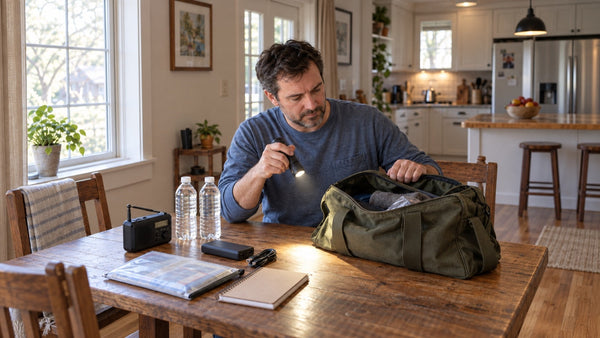
A kit in the garage doesn't help at 2 AM when the bedroom hallway is pitch black. The right power outage preparedness kit staging strategy puts essentials where you'll actually need them:
- Primary staging: A clear plastic bin or duffel in a hall closet near the bedrooms — not shoved behind winter coats
- Vehicle kit: If you're caught away from home during an evacuation or storm, a smaller grab-and-go version in the trunk keeps you covered
- Refresh cycle: Batteries corrode. Food expires. Replace consumables every six months — put it on the calendar when you change your clocks
Frequently Asked Questions
What are the essentials for a power outage kit?
A complete blackout kit includes: reliable flashlights and area lighting, a high-capacity battery bank for device charging, non-perishable food and one gallon of water per person per day, a first aid kit with bleeding control supplies, hand-crank or solar radio for weather alerts, and climate management items (blankets for winter, battery fans for summer). Keep everything in an accessible, known location.
How long can food stay in the fridge during a power outage?
A refrigerator stays below 40°F for approximately 4 hours if kept closed. After that window, perishable foods — especially raw meat, dairy, and leftovers — should be discarded. A full freezer holds temperature for 24-48 hours if untouched. If in doubt, throw it out. Building your power outage preparedness kit around shelf-stable foods removes this anxiety entirely.
How much battery power do I need for a phone during an outage?
A 20,000mAh portable battery bank provides 4-6 full charges for most smartphones. If you need to stretch it across multiple days, switch to low-power mode, reduce screen brightness, and avoid video streaming. Reserve phone use for emergency contact and weather updates — don't burn battery scrolling news feeds.
Related Gear & Guides
- Bug-Out Bag Checklist: Build a 72-Hour Kit That Actually Works
- How to Build a 72-Hour Kit
- Vehicle Emergency Kit Checklist
- Shop Emergency Prep & Survival
- Shop Flashlights & Headlamps
20% off Emergency Preparedness Gear
Use code EDGE20 at checkout · Free U.S. shipping
Shop Emergency PreparednessWas this dispatch helpful?
Thanks for the feedback.

BattleGear™ 132-in-1 Precision Screwdriver Set - Tactical Repair Tool Kit with Magnetic Bits
132 Bits. One Tool. Zero Excuses When Your Gear Needs Fixing. When you're out in the field, at the range, or handlin...