
Nebraska Guard Tests the Communications Behind Disaster Response
A joint exercise near Yutan paired rescue and medical training with the radio links and patient information that help responding teams work together.

In This Dispatch
Around 250 Nebraska National Guard Soldiers and Airmen took part in a disaster-response exercise near Yutan, Nebraska, September 1–3, pairing rescue and medical training with work on the communications that connect responding teams.
The annual joint exercise took place at the Atlas Readiness Center, according to a September 10 report from the 155th Air Refueling Wing. Participants practiced finding and extracting simulated casualties, moving them through decontamination and providing medical care.
Radio interoperability: connecting responding teams
The wing reported that its 155th Communications Squadron used a cross-band system to connect radios operating on different bands. An official photograph from September 2 shows Airmen adjusting the antennas used during the exercise.
The training also included patient tracking. Personnel scanned identification and triage tags to record information such as a patient's condition and destination, according to the wing's report. These were exercise activities involving simulated casualties, rather than a response to an actual disaster.
A response package with several connected jobs
The participating specialized response team is known as a CERFP. The National Guard's fact sheet expands that acronym as a Chemical, Biological, Radiological, Nuclear Enhanced Response Force Package. Its structure brings together command, search and extraction, decontamination, medical support, and fatality search and recovery.
Those elements have different responsibilities. Search personnel locate and remove casualties, including people who cannot move themselves. The decontamination element operates lanes for people who can walk and those who need assistance. Medical personnel conduct triage and coordinate patient tracking and evacuation with the incident commander.
The fact sheet also identifies a communications capability intended to link the response package with local, state and federal partners. That makes communication a defined part of the mission, alongside the more visible work of rescue and care. The command element coordinates assignments with the incident commander and the Homeland Response Force.
Why compatible radios are only part of the picture
The broader challenge is interoperability: responders from different organizations need to exchange information when a shared operation requires it. The Cybersecurity and Infrastructure Security Agency's National Emergency Communications Plan addresses that challenge across agencies, jurisdictions and technologies.
The plan covers six areas: leadership and governance; planning and procedures; training and evaluation; communications coordination; technology and infrastructure; and cybersecurity. Its scope includes voice and other information sharing used during both response and recovery.
This provides useful context for the Nebraska exercise. Equipment is one part of a wider system that also depends on how people organize, practice and coordinate. That connection is an editorial reading of the national framework, rather than a claim that the exercise was evaluated against every goal in the plan.
Practice makes the equipment familiar
In its guidance on communications for planned events, CISA emphasizes opportunities for personnel from different disciplines and jurisdictions to practice with equipment and operating procedures. The guide describes routine use as an important factor in making communications technology effective.
Its examples concern planned community events, such as concerts and festivals. Those settings offer a chance to exercise communications arrangements before an unplanned emergency puts them under pressure. The guide's broader point applies to preparedness: people need opportunities to use the arrangements they may later depend on.
For readers following military readiness and emergency response, that is the useful question to bring to an exercise report: how are the people, procedures and equipment being practiced together? A photograph of an antenna captures one part of that work. The coordination behind it is what gives the equipment its operational purpose.
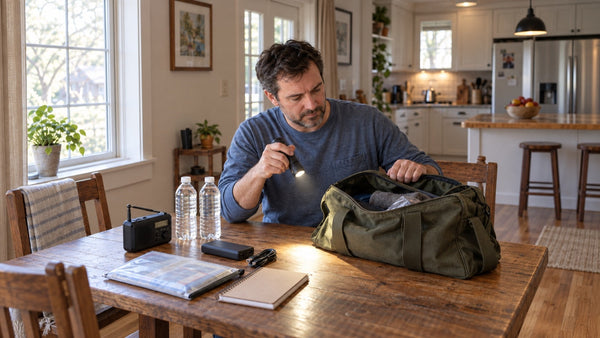
For a practical household starting point, read our 72-hour kit preparation guide.
Sources: 155th Air Refueling Wing exercise report; National Guard CERFP fact sheet; CISA emergency communications guidance; CISA planned-events communications guide.
Photo: U.S. Air National Guard / Master Sgt. Jessica Kind. The appearance of U.S. Department of War (DoW) visual information does not imply or constitute DoW endorsement.
Preparedness starts at home. Explore emergency radios, lighting and everyday supplies for your household plan.
Explore Emergency Prep & Survival →Was this dispatch helpful?
Thanks for the feedback.

BattleGear™ 132-in-1 Precision Screwdriver Set - Tactical Repair Tool Kit with Magnetic Bits
132 Bits. One Tool. Zero Excuses When Your Gear Needs Fixing. When you're out in the field, at the range, or handlin...