
Weekly Dispatch: Army's Containerized Missile System Scores First Kill, plus more from the world of defense
Army counter-drone missiles, Iranian drones over Hormuz, and a new standard for who gets promoted — the week's most consequential defense stories in one briefing.

In This Dispatch
The defense world moved fast this week. From a new Army counter-drone system that scored its first confirmed intercept, to a shootdown of Iranian drones near one of the world's most critical waterways, to a policy shift that will reshape how officers climb the ranks — here's what matters as the week closes out.
Army Grizzly Missile System Takes Down First Drone in Test
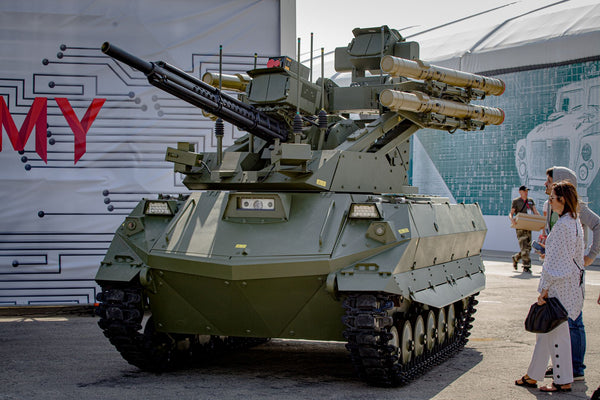
The Army and Lockheed Martin scored a milestone in counter-drone warfare: the GRIZZLY platform — a missile launcher built around a standard shipping container — successfully intercepted and destroyed a Group 3 aerial drone during testing at Yuma Proving Ground, Arizona, on June 3.
The system fires the AGM-179 Joint Air-to-Ground Missile (JAGM) from a vertical launcher derived from the M229 launcher already in heavy military service. What sets GRIZZLY apart is the containerized design: the entire weapons system fits inside a standard shipping container, making it relatively light, highly maneuverable, and — critically — deployable almost anywhere without a permanent installation.
Group 3 drones represent the most operationally relevant threat category right now. This includes platforms like Iran's Shahed-136 — the one-way attack drones that have been used extensively in the conflict between the U.S. and Israel and Iranian proxies — and the American LUCAS derivative. These are mid-sized, relatively cheap, and difficult to intercept with conventional anti-aircraft systems.
The successful intercept marks the first time the GRIZZLY system has taken down a live target. The Army and Lockheed had been developing the platform as part of a broader push to field mobile, low-cost counter-UAS weapons that can protect forward operating bases and fixed installations from drone swarms. Base defense is the stated mission — and the test result is a meaningful proof of concept for that mission.
U.S. Forces Shoot Down Iranian Drones Near Strait of Hormuz
On June 5, CENTCOM confirmed that U.S. forces shot down four Iranian one-way attack drones that had been launched toward the Strait of Hormuz — one of the world's most heavily trafficked maritime chokepoints. U.S. forces subsequently struck Iranian coastal surveillance radar sites on Qeshm Island and at Goruk to deter further launches.
The incident is the latest in a series of kinetic exchanges that have escalated since the ceasefire between the U.S. and Iran was put on hold nearly two months ago. The Strait of Hormuz is a strategic flashpoint: roughly 20% of the world's oil passes through it, and any disruption to shipping has immediate global economic consequences.
Unconfirmed reports emerged online of explosions on Iran's Kharg Island — the country's main oil export facility — during the same window. The timing of those reports aligned with the U.S. intercept operations. If confirmed, an attack on Kharg Island would represent a significant escalation in the ongoing exchange.
The drone threat near the Strait is not new, but the frequency of intercept operations has increased substantially since the ceasefire frayed. For operators and defense planners, the Hormuz corridor remains one of the highest-priority threat zones globally.
Hegseth Makes 'Joint Warfighting Ability' a Promotion Factor for Officers and NCOs
Defense Secretary Pete Hegseth issued a memo on May 20 requiring that "joint warfighting ability" be considered as part of officer and noncommissioned officer evaluation and promotion processes. The directive was confirmed authentic by Task & Purpose.
The memo directs the creation of a new metric to be built into existing evaluation frameworks. Hegseth wrote that the effort "is not a bureaucratic exercise; it is a warfighting imperative." The push for joint capability — the ability to operate across service branches and functional domains — reflects a broader Pentagon priority that has gained urgency as the nature of modern warfare increasingly demands integration across land, sea, air, space, and cyber domains.
Undersecretary of Defense for Personnel and Readiness Anthony Tata has been designated to lead implementation. The memo does not specify how joint warfighting ability will be measured or weighted relative to other promotion criteria — that detail will be developed in the policy guidance Tata's team is tasked with producing.
For service members watching the career pipeline, the change signals that cross-functional operational experience may carry more weight going forward. For defense audiences, it reflects an institutional push toward the kind of integrated capability that peer-adversary scenarios demand.
Navy Fires Entire Leadership of Ship Repair Facility in Japan
The Navy relieved the commanding officer, executive officer, and senior enlisted leader of the ship repair facility at Sasebo Naval Base, Japan, on Wednesday, June 3. Capt. Wendel Penetrante, Capt. Edwin Catubig, and Master Chief Petty Officer Thomas Dean Howell were all removed from their positions. No specific reason for the relief has been publicly stated.
Sasebo is a strategically significant base — it hosts a large portion of the U.S. Navy's forward-deployed fleet in the Pacific and supports maintenance and repair operations for vessels operating throughout the region. Leadership changes at that level are not routine, and the relief of an entire command triumvirate simultaneously is rare.
The timing — amid ongoing maritime tensions in the Pacific and the broader U.S. strategic rebalance toward great-power competition — makes the shakeup notable even without a stated cause. Ship repair readiness directly affects fleet availability, and in a region where deployability is a core strategic metric, any degradation in maintenance infrastructure draws attention.
Air Force Veteran Launches App to Digitize and Preserve Cemetery Records
A small story worth noting on the lighter side: an Air Force veteran has launched Memor, a mobile application designed to digitize and preserve cemetery records and geo-locate gravesites. The app, available on iOS and Android, is aimed at families, veterans organizations, and cemetery managers working to preserve records before they are lost to time and deterioration.
The veteran-founded startup reflects a broader trend in the veteran community leveraging technology for legacy preservation. It's not tactical gear, but it's the kind of bottom-up initiative that often characterizes how veterans approach problems — identifying a gap and building something practical to fill it.
Frequently Asked Questions
What is the Army GRIZZLY system?
The GRIZZLY is a containerized vertical missile launcher developed by Lockheed Martin for base defense and counter-drone operations. It fires the AGM-179 Joint Air-to-Ground Missile (JAGM) and is designed to be mobile, deployable, and relatively low-cost compared to permanent air defense installations.
Why does the Strait of Hormuz matter?
Roughly 20% of the world's oil passes through the Strait of Hormuz, making it one of the most strategically critical maritime chokepoints on the planet. Any disruption affects global energy markets and shipping insurance rates. The U.S. has a long-standing interest in keeping it open.
What does Hegseth's promotion memo mean in practice?
The memo adds "joint warfighting ability" as a formal evaluation criterion for officer and NCO promotions. The specific metrics and weighting haven't been defined yet — that's being developed by Undersecretary Anthony Tata's team. The intent is to reward cross-service operational experience in career advancement decisions.
Sources: Task & Purpose, The War Zone, U.S. Army, Soldier Systems Daily
Tactical gear, range accessories, and survival essentials — priced for shooters who actually use their gear.
Shop the store →Was this dispatch helpful?
Thanks for the feedback.

BattleGear™ 132-in-1 Precision Screwdriver Set - Tactical Repair Tool Kit with Magnetic Bits
132 Bits. One Tool. Zero Excuses When Your Gear Needs Fixing. When you're out in the field, at the range, or handlin...