
EDC Essentials for Beginners: Build Your First Everyday Carry Loadout
The five categories every EDC kit needs — and how to build a loadout you'll actually carry every day.

In This Dispatch
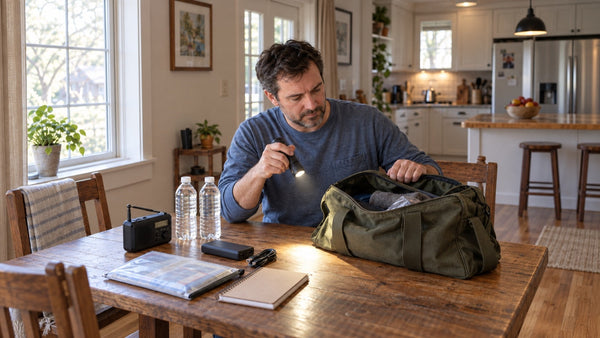
It's 11 p.m. and you flip your car on a dark rural road. No phone signal. No flashlight. You're a mile from the nearest house. In that moment, you understand exactly why operators and experienced shooters talk about everyday carry — and why it's not about paranoia. It's about having what you need before you need it.
EDC essentials for beginners start with understanding that you face real problems every day, and most of them are small: a box you can't open, a screw that needs turning, a light source when the power goes out, a way to cut rope or zip-ties. The gear you carry daily is the gear that solves those problems before they become big ones. This guide walks you through what belongs in an everyday carry setup and how to build one that you'll actually use.
What Is EDC and Why Does It Matter?
EDC stands for everyday carry — the items you have on your person from the moment you walk out the door until you return. For some people, that's a wallet and phone. For others, it's a full loadout of tactical tools and consumables.
Military personnel, law enforcement officers, and experienced gun owners tend to take EDC seriously because they've been in situations where the right tool at the right moment mattered. But here's what many beginners miss: EDC isn't about carrying everything. It's about carrying the right things — items that solve real problems you'll actually encounter, not gear that looks cool on a YouTuber.
The best everyday carry loadout is the one you'll actually bring with you every single day. That means it needs to fit in your pockets, your briefcase, or a small bag — and it needs to stay there without being a burden.
The Core EDC Essentials: The Five Categories That Matter
Every functional EDC setup is built around five categories. These aren't arbitrary — they're the problem categories that come up most often in daily life, whether you're at home, at work, or on the road.
1. Cutting Tool — Knife or Multi-Tool
A knife is the single most versatile tool you can carry. It opens packages, cuts rope or cord, trims branches, handles food prep, pries open lids, and serves as a last-resort defensive tool. For everyday carry, you have two main choices:
- Folding knife — Compact, legal in most jurisdictions, easy to carry in a pocket or on a belt clip. A quality folding knife with a locking blade is safe and practical for daily use.
- Multi-tool — Pairs the knife blade with additional functions: pliers, screwdrivers, a file, a bottle opener. If you work with your hands or need a broader tool set, a multi-tool earns its space on your belt or in your bag.
Look for a blade made from a reliable steel (8Cr13MoV or similar budget-friendly stainless, or higher-end options like S30V if you're willing to spend more). The lock mechanism should be easy to operate with one hand and strong enough that the blade won't close on your fingers.
2. Illumination — Flashlight
Darkness is a problem. Whether you're walking to your car after work, checking a fuse box, or navigating a power outage, a flashlight gives you capability when natural light fails. Your phone flashlight is not a substitute — it dies faster, throws a weaker beam, and you'll drain your phone battery when you might need it for communication.
A good EDC flashlight is compact (3-4 inches fits in a pocket), runs on common batteries (AA, AAA, or a rechargeable 18650/CR123A), and puts out at least 200 lumens — enough to light up a dark room or illuminate a trail at night. Look for a model with a pocket clip and at least two output modes (high and low). Bonus points for a momentary-on tail switch for fast activation.
If you carry a firearm, a weapon-mounted light or a dedicated handheld light that pairs with your carry gun is a natural addition. Check out Military Overstock's flashlight collection for options at every price point.
3. Medical — Compact First Aid
Accidents happen. A kitchen knife slips, a bike chain jams, someone at the range takes a brass burn. A compact first aid kit for EDC doesn't need to be a full IFAK — it needs to handle the small injuries that slow you down if left untreated.
At minimum, carry:
- Bandages — Butterfly closures or standard adhesive bandages in a few sizes
- Antiseptic — Individual antiseptic wipes or a small tube of antibiotic ointment
- Medical tape — A roll of medical tape wraps small items and patches wounds
- Compression bandage — A small Israeli bandage or similar handles larger bleeds
For a more comprehensive carry option, a dedicated trauma or first aid kit from Military Overstock gives you the capacity to handle bleeds, sprains, and penetrating injuries if the situation escalates.
4. Writing & Documentation Tool
You need to write something down every day — a phone number, an address, a note to a colleague, the serial number of a piece of gear. A pen that works when you need it is a genuinely useful EDC item. Tactical pens go a step further: they can break glass in an emergency, write on wet surfaces, and double as a kubotan-style impact tool if things get physical.
If you're at a desk most of the day, a standard good-quality pen (Pilot G2, Uni Jetstream) works fine. If you're on the move, working outdoors, or want the glass-breaker utility, a metal tactical pen is a solid upgrade.
5. Retention & Organization — Small Carry Accessories
The fifth category is where you customize your EDC to your life: wallet, phone, watch, spare batteries, a lighter, a small pry bar, zip ties, or a flashlight ring. Ranger bands — heavy rubber bands originally used by the U.S. Army Rangers — are one of the most versatile and affordable additions to any EDC kit. They secure gear to your belt or pack, bundle items together, work as improvised tourniquets or belt retainers, and weigh almost nothing.
TacBands Ranger Bands from Military Overstock are a perfect example — military-spec rubber loops that have about 200 uses and cost less than a cup of coffee. A pack of five takes up no space and solves small problems all day long.
How to Build Your EDC Loadout: Start Simple, Add Purposefully
Here's the trap most beginners fall into: buying a $300 multi-tool, a $150 flashlight, and a full trauma kit, loading it all into a bulky bag, and then leaving the bag in the car because it's too heavy or inconvenient.
Your beginner EDC setup should do the opposite. Start with what you'll actually carry every day:
- Start with two items. A folding knife and a flashlight. Carry them for a week in whatever pocket feels natural. Notice when you reach for them.
- Add the next layer. Once the knife and light are habits, add a multi-tool if you find yourself needing screwdrivers or pliers. Add a pen if you write things down daily.
- Build your medical kit. A small zippered pouch with a few bandages and antiseptic wipes goes a long way. Upgrade to a full IFAK when you understand what level of medical response you want to carry.
- Optimize for your environment. Office EDC looks different from field EDC. If you're behind a desk, a compact flashlight and a good pen might be all you need daily. If you're on a job site or outdoors, add the multi-tool and heavier medical kit.
The goal is a loadout that feels like part of your clothing — present, accessible, and not a burden. When it clicks, you'll wonder how you managed without it.
The EDC Mindset: Carry with Intention
The gear only works if you have it when you need it. That means every item in your EDC rotation has to pass one test: will I use this at least once a week? If the answer is no, it's not EDC — it's a backup item, and it belongs in the car or the range bag, not your daily pockets.
This is also why pocket dumps matter. When you get home, put the gear back in the same pockets. When you leave, check those pockets before you walk out the door. EDC is a habit loop, not a shopping list.
If you're transitioning from a pure tactical or shooting focus to everyday carry, you're already ahead of most people. You understand weapon retention, threat assessment, and the value of having a tool ready before you need it. Apply the same discipline to your everyday carry and you'll develop a loadout that's genuinely useful rather than just heavy.
Everyday Carry on a Budget: Where to Start
You don't need expensive gear to have a functional EDC. The essentials — a decent folding knife, a AA-powered flashlight, a roll of medical tape, and a pack of ranger bands — cost under $50 total and cover the vast majority of everyday problems.
Military Overstock's EDC gear collection is built around exactly this philosophy: gear that works, priced for people who actually use it, not collectors who display it. The GO-Bag Tactical Sling is a great carry option if you want to expand beyond pockets — it's compact enough for daily use but has enough organization to keep your EDC items from rattling around at the bottom of a bag.
Buy the best knife and flashlight you can afford, and add the rest of the categories over time. Your EDC evolves with your experience — there is no perfect first loadout, only a starting point.
Frequently Asked Questions
What are the must-have EDC items for beginners?
The five essential EDC categories are a cutting tool (knife or multi-tool), illumination (flashlight), basic medical supplies, a writing instrument, and small retention or organization accessories like ranger bands. Start with the knife and flashlight, then add the other categories as they become habits.
Is it legal to carry a knife and flashlight every day?
In most U.S. states, carrying a folding knife with a blade under 3-4 inches is legal in everyday situations. Ballistic helmets and defensive tools have their own local regulations. Check your state and local laws before carrying any self-defense-related item, and always carry responsibly.
What's the difference between EDC and a bug-out bag?
An EDC kit is what you carry on your person every day — lightweight, pocket-friendly items that address immediate problems. A bug-out bag is a larger kit designed to sustain you for 72+ hours away from home. Your EDC items feed into your bug-out bag: the flashlight, knife, first aid, and other gear you carry daily become the foundation of your emergency kit.
How much should a beginner spend on EDC gear?
You can build a functional everyday carry kit for under $50 with a budget folding knife, a basic flashlight, medical tape, and ranger bands. Quality matters more than quantity — a $40 knife that holds an edge beats a $10 knife that doesn't. Upgrade individual items as they wear out or as your needs evolve.
Related Gear and Guides
- The Complete EDC Gear Guide — The parent pillar covering every EDC category in depth
- Shop EDC Gear — Browse the full Military Overstock EDC collection
- Tactical Flashlights — Every-day illumination options for carry and home
20% off EDC Gear & Everyday Carry Essentials
Use code EDGE20 at checkout · Free U.S. shipping
Shop EDC EssentialsWas this dispatch helpful?
Thanks for the feedback.

BattleGear™ 132-in-1 Precision Screwdriver Set - Tactical Repair Tool Kit with Magnetic Bits
132 Bits. One Tool. Zero Excuses When Your Gear Needs Fixing. When you're out in the field, at the range, or handlin...